

The first time I made European Butter Croissant Dough at home, I thought I was being brave and a little delusional. Croissants always felt like “bakery people” food, not “three kids, homework on the counter, and someone asking what’s for dinner” food. But one snowy Saturday in NYC, we stayed in on purpose. I needed a cozy project, and the kids needed something to do that did not involve arguing over a screen.
Lily lined up the measuring spoons like she was running a tiny baking lab. Noah took the job of “butter inspector” very seriously. Emma, of course, wanted the rolling pin and the mixing spoon at the same time. We made a mess, we laughed, and we learned quickly that a good Croissant Recipe is part patience, part timing, and part trusting your hands.
Eva’s Note: The moment that hooked me was the smell. That warm, buttery, toasty aroma makes your whole home feel safe and soft around the edges, even if the sink is full of dishes.
I’ve always had a soft spot for pastries, and that love has only grown since I started baking more at home. If you’re in a pastry mood after this, you might also enjoy my love for pastries, it’s another weekend treat that feels like a hug.
Why European-Style Butter Makes a Difference
If you’ve ever wondered why some croissants taste deeply buttery and shatter into delicate flakes, while others feel more like soft bread, butter is a big part of the answer. European-style butter usually has a higher butterfat percentage than standard butter. That extra fat means less water, and less water means better lamination and a richer flavor.
Key fact: In laminated pastry dough, the butter is not just flavor, it is structure. Those thin sheets of butter create separation between layers of dough. In the oven, the butter melts and the moisture in the dough turns to steam, lifting the layers like tiny pages in a book.
Key fact: Higher-fat butter tends to be more pliable when cold. That matters because the butter has to roll out evenly without cracking or melting too fast. When the butter stays in a smooth sheet, you get clean layers. When it breaks or leaks, the layers suffer.
This is why a Butter Croissant Recipe can live or die on butter choice and temperature. It is also why so many bakers swear by European butter for a classic French Croissant Recipe. You can absolutely make Homemade Croissants with regular unsalted butter, but if you want that bakery-style flavor and those gorgeous layers, European-style butter gives you a real advantage.
I like to think of it like this. If croissants are a little weekend luxury, then good butter is the comfy robe you put on to fully commit to the vibe.
Essential Ingredients for Perfect Croissants
Before we roll anything out, let’s talk ingredients. Croissants are simple on paper, but each ingredient has a job. Think of this as your grocery list plus your confidence boost.
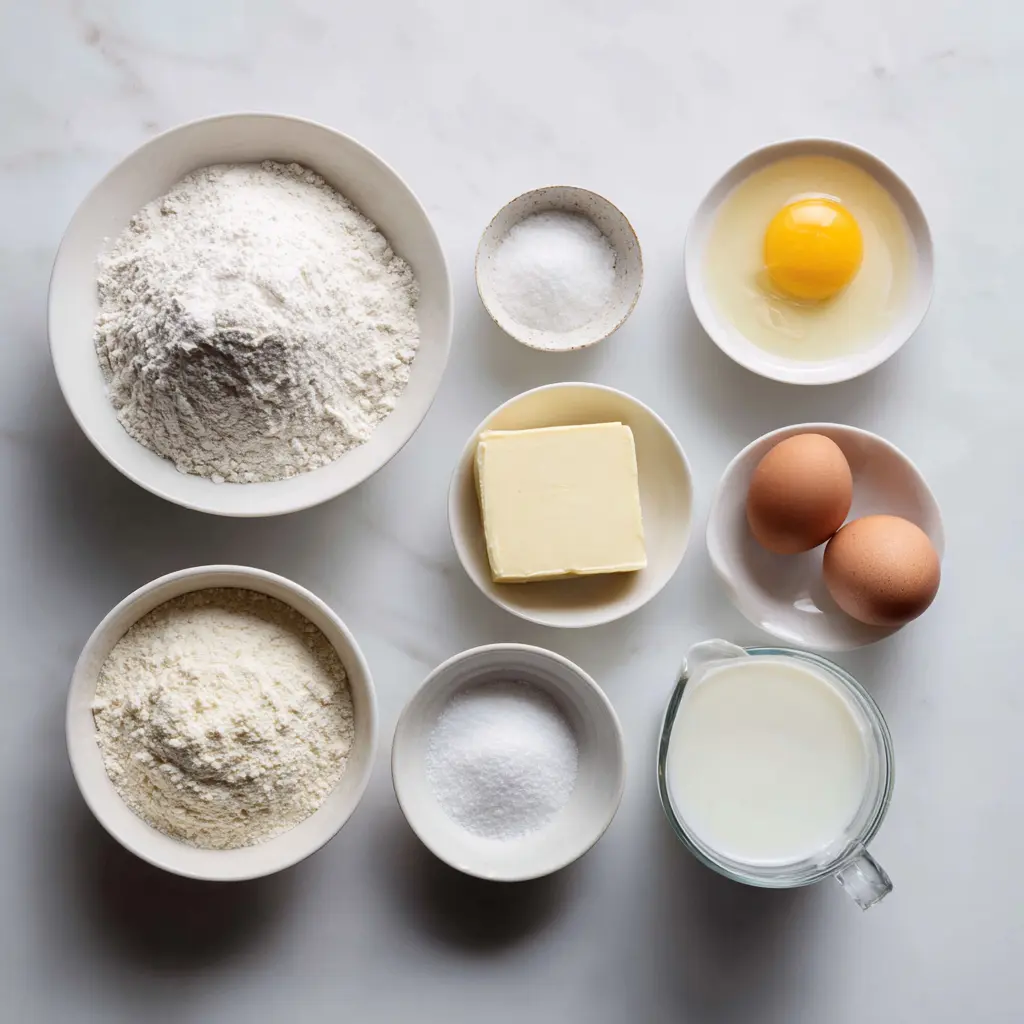
- **500 g** bread flour (or strong all-purpose flour)
- **60 g** granulated sugar
- **10 g** fine sea salt
- **7 g** instant yeast (or active dry yeast)
- **300 g** cold whole milk (plus a splash if needed)
- **40 g** unsalted butter, softened (for the dough)
- **280 g** European-style unsalted butter, cold (for lamination)
- **1** large egg (for egg wash)
- **1 Tbsp** milk (for egg wash)
Ingredient notes that make a big difference:
- Flour: Bread flour gives you stronger gluten, which helps the Croissant Dough Recipe stretch without tearing during rolling. If you only have all-purpose flour, you can still make it work, just be gentle and expect slightly less chew.
- Yeast: Instant yeast is easy for busy schedules because it mixes right in. If you use active dry yeast, dissolve it in a little of the milk first (lukewarm, not hot) and give it a few minutes to foam.
- Milk: Whole milk adds tenderness and flavor. Keep it cold so the dough stays cool while you work.
- Salt: Croissants without enough salt taste oddly flat. Salt also strengthens gluten, which helps when you’re building layers.
- Butter: For Homemade Croissants, use the best butter you can. The butter flavor is front and center, and it’s what makes the whole project feel worth it.
Eva’s Note: If your kitchen runs warm (hello, tiny NYC apartments), chill your mixing bowl for a few minutes before you start. It sounds extra, but it saves you stress later.
Step-by-Step Guide to Making Croissant Dough
This is the base dough, the part that sets you up for success before the lamination begins. If you’re new to Laminated Pastry Dough, take a breath. We are doing this one calm step at a time.
- Mix the dry ingredients. In a large bowl (or stand mixer bowl), combine the flour, sugar, salt, and yeast. Stir to distribute everything evenly.
- Add the milk and softened butter. Pour in the cold milk and add the softened butter for the dough. Mix until a shaggy dough forms.
- Knead gently. Knead by hand for about 5 to 7 minutes, or with a mixer on low for about 3 to 4 minutes, until the dough looks smooth and elastic. It should feel cool and slightly firm, not sticky. If it’s dry, add a tiny splash of milk.
- Shape and chill. Press the dough into a rectangle (about 1 inch thick). Wrap tightly and refrigerate for 1 to 2 hours, or until very cold.
- Make the butter block. Place the cold European-style butter between two sheets of parchment paper. Pound and roll it into a neat rectangle (about 6 x 8 inches). Keep it cold, but pliable. Refrigerate until needed.
- Check temperatures before you laminate. This is the beginner mistake that causes most croissant heartbreak. The dough should be cold and relaxed. The butter should be cold but bendable. If either one feels off, chill for 10 minutes and try again.
Common beginner mistakes (and how to avoid them):
- Over-kneading: You want gluten development, but not a tight, springy dough that fights you. Stop when it’s smooth.
- Warm dough: Warm dough makes lamination harder because the butter melts into it instead of staying in layers.
- Rushing the chill: A good Authentic French Croissant Recipe is built on rest. The fridge time is not wasted time, it’s what makes rolling possible.
Eva’s Note: I used to try to “power through” the steps. Now I treat the resting time like a little break for me too. Fold laundry, answer a text, make tea, breathe. The dough will be better for it.

The Art of Lamination
Lamination is the heart of the French Baking Recipes we all daydream about, those crisp, flaky layers that pull apart like soft ribbons. It’s also the part that feels intimidating until you do it once. Then it becomes oddly soothing, like you’re building something with your hands that you can actually see.
What you’re aiming for: Thin, even layers of dough and butter stacked through folds. The goal is not perfection, it’s consistency. Keep your edges tidy, keep your flour light, and keep everything cool.
Locking in the Butter
- Roll the dough. On a lightly floured surface, roll your chilled dough into a rectangle about 8 x 12 inches. Try to keep corners squared.
- Add the butter block. Place the butter block in the center of the dough so it looks like a book on a table.
- Fold the dough over the butter. Fold the dough over the butter to fully enclose it, like wrapping a present. Pinch seams closed so butter does not escape.
- Chill if needed. If the butter feels too soft, refrigerate for 10 to 15 minutes before rolling.
Folding Schedule (Three Folds)
Most croissant dough needs three folds for beautiful layers. Here’s a simple way to think about it, and yes, this is your little diagram in words.
Letter fold (single fold) diagram:
Roll into a long rectangle. Then fold the top third down, and fold the bottom third up, like folding a letter.
- First fold: Roll the dough into a long rectangle (about 8 x 18 inches). Do a letter fold. Wrap and refrigerate for at least 30 minutes.
- Second fold: Turn the dough 90 degrees so the open ends face left and right. Roll again into a long rectangle. Do another letter fold. Wrap and refrigerate for at least 30 minutes.
- Third fold: Repeat the turn, roll, and letter fold one last time. Wrap and refrigerate for 1 hour (or overnight if that fits your life better).
Sensory cues to watch for:
- When it’s right: The dough feels cool, smooth, and rolls without butter smearing. You can see faint butter marbling under the surface.
- When it’s too warm: The dough looks shiny, feels sticky, or you see butter trying to ooze out. Pause and chill.
- When it’s too cold: The dough resists rolling and the butter feels like it might crack. Let it sit at room temperature for 5 minutes, then try again.
Eva’s Note: The first time I got clean layers, I literally held the dough up like a trophy. Noah said, “Mom, it’s just dough.” Then he ate two croissants and changed his opinion.
Troubleshooting Common Croissant Issues
Croissants humble all of us. I have had batches that looked like they belonged in a bakery window, and batches that looked like puffy little triangles with identity issues. Here are the problems I see most often, and what actually helps.
Why are my croissants leaking butter in the oven?
This usually happens when the butter got too warm during lamination or proofing, or when the layers were damaged by aggressive rolling. Chill the dough whenever it starts to feel soft. Also make sure your shaped croissants proof at a cool room temperature. If your kitchen is hot, proof them in the oven with the light off and a bowl of warm water on the bottom rack, but keep an eye on them.
Why is my croissant dough tearing during lamination?
Tearing is often a sign the dough is too cold and tight, or it did not rest long enough between folds. It can also happen if your dough is under-kneaded and lacks strength. Let the dough rest in the fridge between folds, and if it fights you, give it 5 minutes on the counter before rolling again.
My dough keeps shrinking back when I roll it
That’s gluten doing its thing. It needs rest. Wrap the dough and chill for 20 to 30 minutes, then try again. This is not failure, it’s just the dough asking for a break.
My layers look uneven
Uneven layers usually come from uneven rolling. Try to roll from the center outward, and check thickness with your hands. If one area feels thicker, focus your rolling pressure there. Also, keep your corners squared as you go. A bench scraper can help nudge edges into shape.
Creative Shaping and Filling Ideas
Once your dough is laminated and rested, shaping is the fun part. This is where Homemade Croissants start to feel like something you’d proudly bring to brunch, even if brunch is just you and a mug of coffee before the house wakes up.
Classic Crescent Croissants
Roll the dough into a large rectangle (about 10 x 20 inches), around 1/8-inch thick. Trim edges for clean layers, then cut long triangles. Stretch each triangle gently, then roll from the wide end to the tip. Curve the ends inward slightly for that classic French Croissants look.
Large Croissant Recipe Style (Bigger Bakery Size)
If you want big, dramatic croissants, cut fewer, wider triangles. The trick is giving them enough proofing time so the centers bake up airy, not doughy.
Simple filling ideas (keep it light)
- Chocolate: Add a couple of batons or a few chocolate chips near the wide end before rolling.
- Jam: A thin smear is enough. Too much will leak and glue layers together.
- Sweet cream cheese: Mix cream cheese with a little sugar and vanilla, then use a small spoonful.
- Savory: A sprinkle of shredded cheese and herbs is lovely, especially for a more dinner-friendly twist.
Eva’s Note: Emma’s favorite is “chocolate, but extra.” I’ve learned to keep the filling modest, then serve warm croissants with a little chocolate spread on the side. Less leaking, more happiness.
Storing, Freezing, and Reheating Croissants
Croissants are best the day they’re baked, but real life does not always line up with fresh-from-the-oven timing. Here’s how to keep them tasting great, plus a few tricks I’ve learned from busy weeks.
How do you store croissant dough before baking?
- In the fridge: After the final fold, you can refrigerate the dough overnight. This is my favorite option because it makes the process feel calmer.
- Shaped, unbaked croissants: You can shape them, place on a tray, cover well, and refrigerate overnight. In the morning, let them proof at room temperature until puffy, then bake.
Can you freeze European Butter Croissant Dough?
- Freeze the laminated dough: After the third fold, wrap tightly and freeze for up to 1 month. Thaw overnight in the refrigerator before rolling and shaping.
- Freeze shaped, unbaked croissants: Shape them, freeze on a tray until firm, then store in a freezer bag. Thaw overnight in the fridge, then proof and bake.
- Freeze baked croissants: Let them cool completely, wrap well, and freeze. Reheat straight from frozen for best texture.
Reheating (so they stay crisp)
- Oven: 325°F for 8 to 12 minutes, until warmed through and crisp again.
- Air fryer: 300°F for 3 to 5 minutes, check early.
- Microwave: Not ideal for crispness, but if you must, do 10 to 15 seconds, then finish in a toaster oven if you can.
If you want more baking tips, I have another cozy croissant-style bake that’s great when you want the flavor without quite as much rolling.
Frequently Asked Questions about European Butter Croissant Dough
Q: How do you make European Butter Croissant Dough flaky?
✅ Answer: Use high-fat butter and precise folding techniques.
When the butter has a higher fat content, it creates stronger, cleaner layers during lamination. Then the folding builds those layers into a stack that puffs in the oven. My favorite part is hearing that first crunch when you bite into a croissant that actually flakes, the kind where you need a plate because the crumbs are going everywhere.
Q: What butter is best for European Butter Croissant Dough?
✅ Answer: High-fat, unsalted butter is ideal for lamination.
Look for European-style unsalted butter, since it tends to be higher in butterfat and more pliable when cold. The aroma alone is worth it. When I unwrap a really good butter, it smells clean and rich, and it makes the whole kitchen feel like a real bakery for a minute.
Q: Why is my croissant dough tearing during lamination?
✅ Answer: Ensure dough and butter are at similar temperatures.
If the butter is too cold, it can crack and create sharp edges that tear the dough. If the dough is too cold, it can resist stretching and split. I learned this in a baking class years ago when the instructor kept saying, “Match the textures.” Now I do a quick test, I press the butter with my finger. It should dent without feeling greasy.
Q: How many folds does European Butter Croissant Dough need?
✅ Answer: Typically, three folds result in optimal layers.
Three letter folds are the sweet spot for most home bakers. It builds plenty of layers without making the dough so thin that it becomes hard to manage. I always feel a little proud after the final fold, like I just finished a tiny marathon that ends with breakfast.
Q: How long should croissant dough rest between folds?
✅ Answer: Rest the dough for at least 30 minutes between folds.
This rest time chills the butter and relaxes the gluten, which makes rolling smoother and helps prevent tearing. I usually make a cup of tea and enjoy the quiet while the dough rests. It turns the whole process into something peaceful instead of stressful.
Q: Can you make European Butter Croissant Dough ahead of time?
✅ Answer: Yes, it can be prepared a day in advance.
You can do the folds the day before, then roll and shape the next day. Planning ahead is the secret to making a French Croissant Recipe feel doable on a weekend. When I prep the dough in advance, Saturday morning baking feels less like a project and more like a treat.
If you’ve been wanting to try a Croissant Recipe at home, I hope this European Butter Croissant Dough gives you that gentle push. Keep it cool, give it time, and let the process be a little slower than your normal day. When you pull a tray of Homemade Croissants from the oven and hear that delicate crackle as they cool, it feels like you made something truly special with your own two hands.
Thank you for cooking with me, it means the world to have you in my kitchen.
Come hang out with me on Pinterest for more cozy bakes and family favorites.

European Butter Croissant Dough Recipe
- Total Time: 50
- Yield: 12 1x
- Diet: Vegetarian
Description
European Butter Croissant Dough creates flaky, buttery croissants with classic laminated layers, rich flavor, and a light airy interior.
Ingredients
500 g bread flour (or strong all-purpose flour)
60 g granulated sugar
10 g fine sea salt
7 g instant yeast (or active dry yeast)
300 g cold whole milk (plus a splash if needed)
40 g unsalted butter, softened (for the dough)
280 g European-style unsalted butter, cold (for lamination)
1 large egg (for egg wash)
1 Tbsp milk (for egg wash)
Instructions
1. Mix the dry ingredients. In a large bowl (or stand mixer bowl), combine the flour, sugar, salt, and yeast. Stir to distribute everything evenly.
2. Add the milk and softened butter. Pour in the cold milk and add the softened butter for the dough. Mix until a shaggy dough forms.
3. Knead gently. Knead by hand for about 5 to 7 minutes, or with a mixer on low for about 3 to 4 minutes, until the dough looks smooth and elastic. It should feel cool and slightly firm, not sticky. If it’s dry, add a tiny splash of milk.
4. Shape and chill. Press the dough into a rectangle (about 1 inch thick). Wrap tightly and refrigerate for 1 to 2 hours, or until very cold.
5. Make the butter block. Place the cold European-style butter between two sheets of parchment paper. Pound and roll it into a neat rectangle (about 6 x 8 inches). Keep it cold, but pliable. Refrigerate until needed.
6. Check temperatures before you laminate. This is the beginner mistake that causes most croissant heartbreak. The dough should be cold and relaxed. The butter should be cold but bendable. If either one feels off, chill for 10 minutes and try again.
Notes
Bread flour gives you stronger gluten, which helps the Croissant Dough Recipe stretch without tearing during rolling.
Instant yeast is easy for busy schedules because it mixes right in.
Whole milk adds tenderness and flavor. Keep it cold so the dough stays cool while you work.
Croissants without enough salt taste oddly flat.
For Homemade Croissants, use the best butter you can.
If your kitchen runs warm, chill your mixing bowl for a few minutes before you start.
- Prep Time: 30
- Cook Time: 20
- Category: Breakfast
- Method: Baked
- Cuisine: French
Nutrition
- Serving Size: 1 croissant
- Calories: 250
- Sugar: 5
- Sodium: 200
- Fat: 15
- Saturated Fat: 9
- Unsaturated Fat: 5
- Trans Fat: 0
- Carbohydrates: 25
- Fiber: 1
- Protein: 5
- Cholesterol: 40